
ISLAMABAD, Nov 2 (Focus Pakistan) — The proposed Pakistan LNG storage project could give the country its first large, dedicated LNG reserve facility after the Hormuz supply shock exposed vulnerabilities in imported gas supplies. A US-led consortium, with reported support from the Trump administration, wants to invest up to $4.4 billion in storage, regasification and a pipeline linking Port Qasim to northern consumers.
The consortium, led by Global Vision Energy Partners (GVEP) and its related firm Khanjee Holdings, is pushing an integrated LNG project worth up to $4.4 billion. The plan covers imports, storage, regasification, pipeline transmission and direct sales to large consumers on a merchant basis, according to the proposal. Luxembourg-based General Mediterranean Holding has also joined.
The pitch lands soon after Energas walked away from a similar scheme. That venture, which paired the Lucky Group with Qatar Energy, blamed fundamental shifts in Pakistan’s energy policy and fiscal issues that stayed unresolved for years. Energas also pointed to a government energy study from March 2025. According to the company, the study found Pakistan would need no new LNG terminals for five years.
That finding hangs over the new pitch. The country may not need more import capacity so much as somewhere to put the gas.
Too much gas, then too little
Pakistan’s recent swings make that case on their own. In a March briefing, the Institute for Energy Economics and Financial Analysis (IEEFA) found that LNG consumption fell by 1.21 million tonnes in 2025 as solar power spread. Long-term purchase commitments left Pakistan facing surplus contracted cargoes as demand weakened. The absence of dedicated onshore storage further limited its ability to manage short-term supply imbalances.
Also Read: Pakistani Tycoons Can’t Open New Banks, but Foreigners Still Can
The 2026 Middle East conflict then reversed the situation. Damage at Qatar’s Ras Laffan facility and disruptions around the Strait of Hormuz cut supplies. Qatar shipped just six cargoes to Pakistan through the waterway during the disruption, and the country’s LNG surplus disappeared, according to IEEFA.
Pakistan LNG Limited turned to the spot market. In July it paid TotalEnergies $21.88 per mmBtu for a single 140,000-cubic-metre cargo, the highest price Pakistan has paid for a spot cargo since the conflict began. That cargo was its seventh spot purchase since QatarEnergy declared force majeure in March.
Dedicated storage could help Pakistan absorb short-term supply shocks. It would not remove the risks of prolonged import disruptions or inflexible purchase contracts.
Four tanks, one big gap
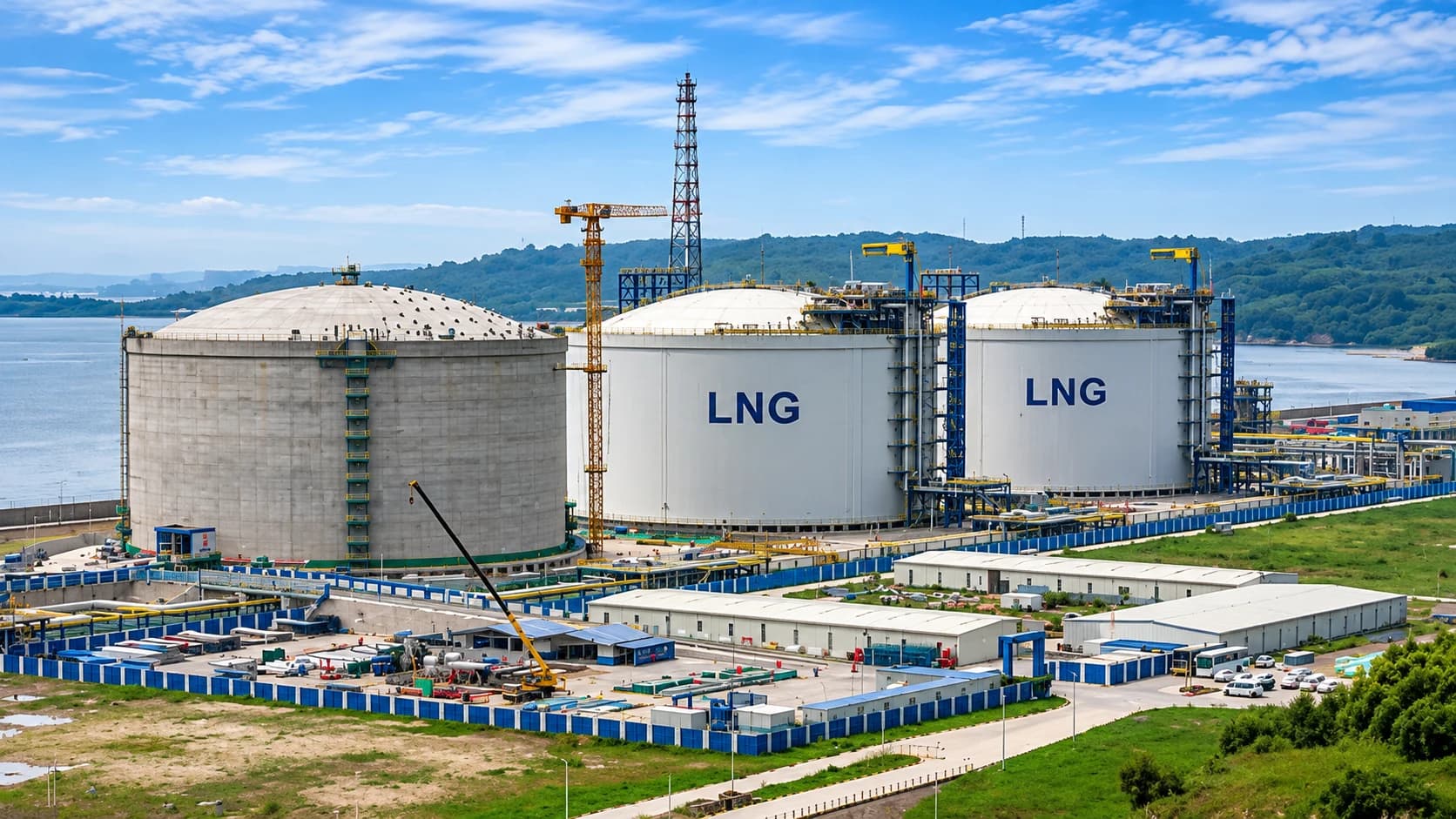
The first phase of the Pakistan LNG storage project would cost $1.7 billion and include four tanks with combined capacity of 560,000 cubic metres. Each tank would have a nominal capacity of 140,000 cubic metres, matching the size of the LNG cargo Pakistan contracted from TotalEnergies in July. At three inventory turns a year, the facility could handle the equivalent of 35.6 billion cubic feet of natural gas annually and hold about 11.9 BCF in gas equivalent when full.
Phase two goes much bigger. The sponsors want to lay a 1,100km pipeline, 42 to 48 inches wide, to carry around 1.2 billion cubic feet a day upcountry. That capacity would exceed the terminal’s projected average throughput by more than twelvefold. The available project details do not explain whether other gas supplies would use the pipeline or how the sponsors expect to utilise its full capacity.
What it would cost users
The Pakistan LNG storage project would carry proposed terminal and transmission charges totalling $6.84 per mmBtu during its first decade. The consortium estimates terminal and storage charges at $4.93 per mmBtu, with another $1.91 for pipeline transmission. These combined charges exclude the cost of the gas itself and would apply to customers using both services. The combined rate would fall to $3.12 per mmBtu after the first decade.
These are the consortium’s numbers. Ogra has not approved any of them.
Big names, no signatures
The sponsors plan a 70:30 debt-to-equity structure. GVEP would hold 26pc, General Mediterranean Holding 24pc, and Khanjee Holdings and strategic co-investors 20pc each. Local investors could take the last 10pc, with tickets starting at $50 million.
The proposal names KKR, Blackstone, Grey Rock Investment Partners, Saudi Arabia’s Public Investment Fund and the Kuwait Investment Authority as possible co-investors. None of them has made a binding commitment.
The sponsors have filed for a provisional licence with Ogra and incorporated a special purpose vehicle. They report consent from the Port Qasim Authority for the site. The proposal has qualified for consideration under a US Trade and Development Agency project preparation programme, but the available project details show no binding US government financing commitment.
The Hormuz factor
Port Qasim lies outside the Strait of Hormuz, and this year showed why that matters. The sponsors want a base that US and Middle Eastern suppliers can use to serve South Asia, with Pakistan’s own market as the anchor customer.
Engineering, procurement and construction contracts will decide the final bill. Until investors sign, the $4.4 billion remains an ambition rather than money on the table.