

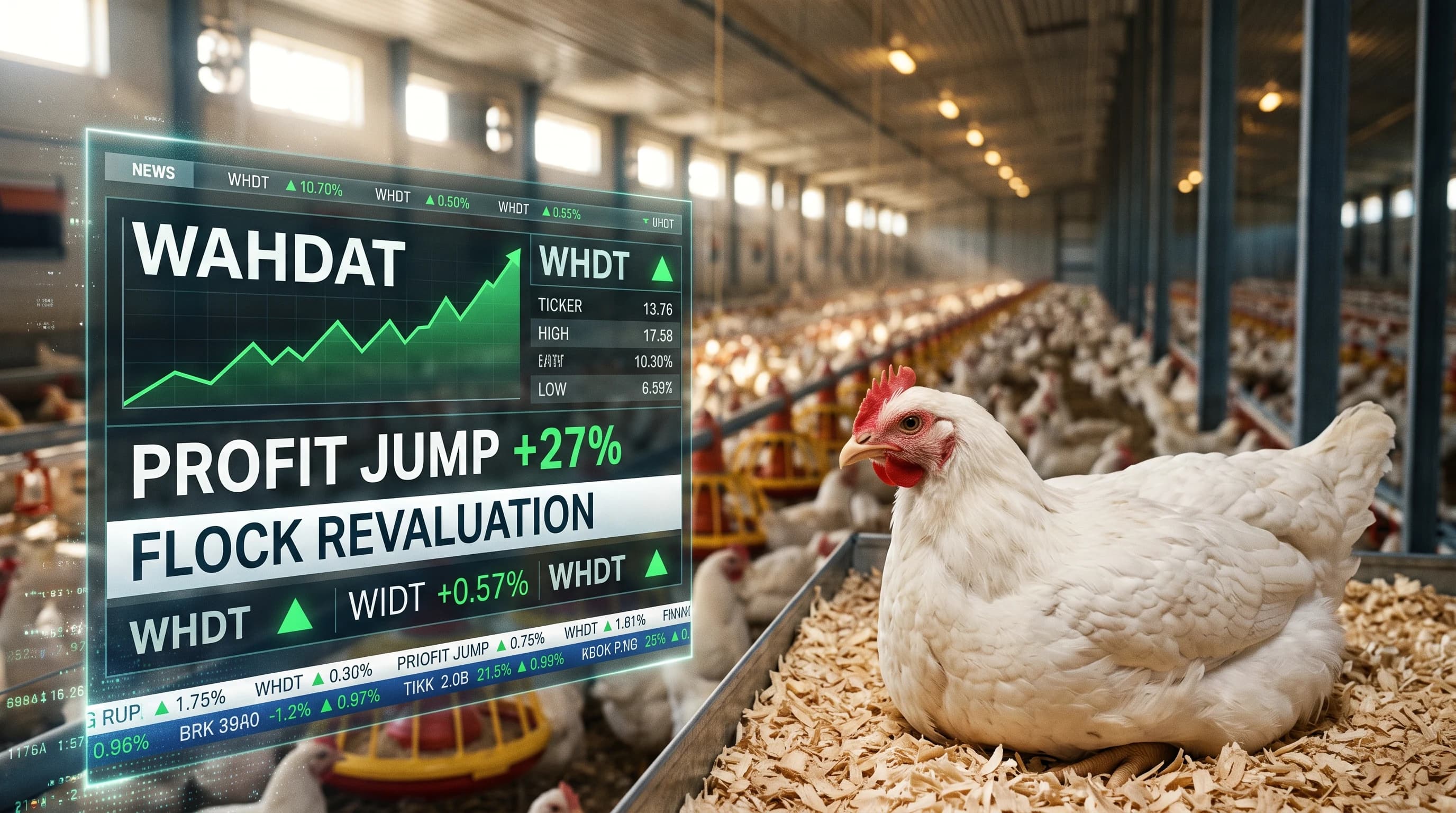
KARACHI, October 15 (Focus Pakistan) – Wahdat Poultry Farm Limited closed its first year as a listed company with a 26.6% increase in net profit to Rs306.3 million in FY26, supported by stronger operating performance and a sharp increase in the fair value of its laying flock.
The Farm Fresh Eggs producer recorded a fair value gain of Rs207 million on its laying hens during the financial year, compared with Rs86 million in FY25, according to an analyst report on the company’s annual results.
The gain amounted to approximately 67.6% of reported net profit, highlighting its significance in the company’s earnings. However, the figure represents a comparison of two separate accounting measures, not the share of profit directly attributable to flock revaluation. Taxes and other accounting adjustments also affect the final result.
Despite the non-cash boost, the company’s operating business continued to expand. Revenue reached Rs3 billion, while operating profit increased 26.5% to Rs446.4 million. Operating margins improved to 14.9% from 12.6% a year earlier, as costs grew more slowly than total operating income. Selling and distribution expenses increased by just 2%.
Since FY21, Wahdat Poultry’s revenue has grown at a compound annual growth rate of 19.5%, reflecting the expansion of its branded egg business.
Rs846 Million in IPO Proceeds Remains Partly Unspent
Wahdat Poultry made its debut on the Pakistan Stock Exchange’s main board on May 8 at a strike price of Rs18 per share.
The company raised Rs900 million through the issuance of 50 million new shares, while existing shareholders sold an additional 3.1 million shares as part of the same offering. The secondary sale generated approximately Rs56 million for the selling shareholders, rather than the company.
After expenses, Wahdat retained net proceeds of Rs846.4 million. By the end of FY26, it had utilised Rs407.8 million, leaving Rs438.6 million unspent.
The largest single allocation, Rs125.1 million, went towards a new pasteurisation plant. The company also allocated Rs110 million to working capital and Rs89.6 million to flock rearing. It repaid Rs50 million owed to Karandaaz Pakistan and set aside another Rs33 million for its quality-assured procurement model.
Debt repayment has helped reduce financing expenses. Finance costs fell 20.6% to Rs105.7 million during FY26, while interest-bearing debt declined to 0.28 times equity, compared with 0.54 times in the previous year.
The company ended the financial year with Rs513.4 million in cash and bank balances, up from Rs40.7 million a year earlier.
The IPO proceeds also strengthened the balance sheet. Total assets increased 46.5% to Rs3.75 billion, while shareholders’ equity rose 75.2% to Rs2.68 billion. Equity consequently accounted for 71.5% of total assets, compared with 59.9% in FY25.
Wahdat’s biological assets, comprising its laying flock, were valued at Rs970.2 million at year-end.
Gulf Export Sales Decline as Cash Conversion Cycle Lengthens
Despite growth in its domestic business, Wahdat Poultry faced setbacks in its Gulf export markets.
Sales to the United Arab Emirates fell 42.8% to Rs250.5 million in FY26 from Rs438.3 million a year earlier. Exports to Qatar, which generated Rs16.7 million in FY25, ceased entirely during the latest financial year.
Branded eggs continued to dominate the business, accounting for 97% of total revenue. This concentration makes the performance of the core egg business and the development of additional product categories particularly important to future growth.
Cash flow indicators also point to mounting working capital requirements. The company’s cash conversion cycle lengthened to 94 days from 88 days as both receivable and inventory days increased.
Free cash flow to the firm turned negative at Rs240.5 million, equivalent to a margin of approximately minus 8%. Expansion expenditure, including investment in the pasteurisation plant, exceeded the cash generated by the business.
The company’s operating capacity presents another challenge. Its laying flock reached 452,437 birds in FY26, exceeding its reported installed capacity of 430,000 birds by approximately 5.2%.
Meanwhile, the feed mill operated at 40 tonnes per day against installed capacity of 80 tonnes, representing utilisation of 50%.
These figures highlight the importance of balancing flock expansion, feed production and processing capacity with demand, particularly as the company invests in new product lines and seeks to rebuild export sales.
Pasteurised Liquid Egg Plant Targets March 2027 Launch
Wahdat Poultry plans to commence operations at its pasteurisation plant in March 2027, marking a potential shift beyond its traditional shell egg business.
The facility is expected to enable the company to supply pasteurised liquid eggs to bakeries, food manufacturers and food-service businesses. The product could open up additional domestic revenue streams while providing a new offering for customers in the Gulf Cooperation Council region and other export markets.
The investment comes as the company seeks to diversify its product portfolio and reduce its reliance on branded shell eggs. However, the project's contribution will depend on its timely commissioning, customer acquisition, production economics and the recovery of export demand.
Wahdat Poultry has not paid dividends to shareholders to date, with management reinvesting earnings into expansion. According to the analyst report, the stock trades at 15.4 times FY26 earnings.
FY27 to Test the Quality of Earnings Growth
Wahdat Poultry enters FY27 with a stronger balance sheet, lower financing costs and a growing core business, but its latest results also highlight the difference between accounting earnings and cash generation.
The Rs207 million fair value gain on its laying flock supported reported profitability without generating equivalent cash inflows. Meanwhile, negative free cash flow and a longer cash conversion cycle underline the financial demands of the company’s expansion programme.
The next phase of growth will depend on whether the pasteurisation plant begins operations as planned, whether liquid egg products gain traction among commercial buyers, and whether export sales to the UAE and other Gulf markets recover.
For investors, FY27 will be an important test of whether Wahdat Poultry can translate its investments and accounting gains into sustained operating cash flow and more diversified revenue growth.