
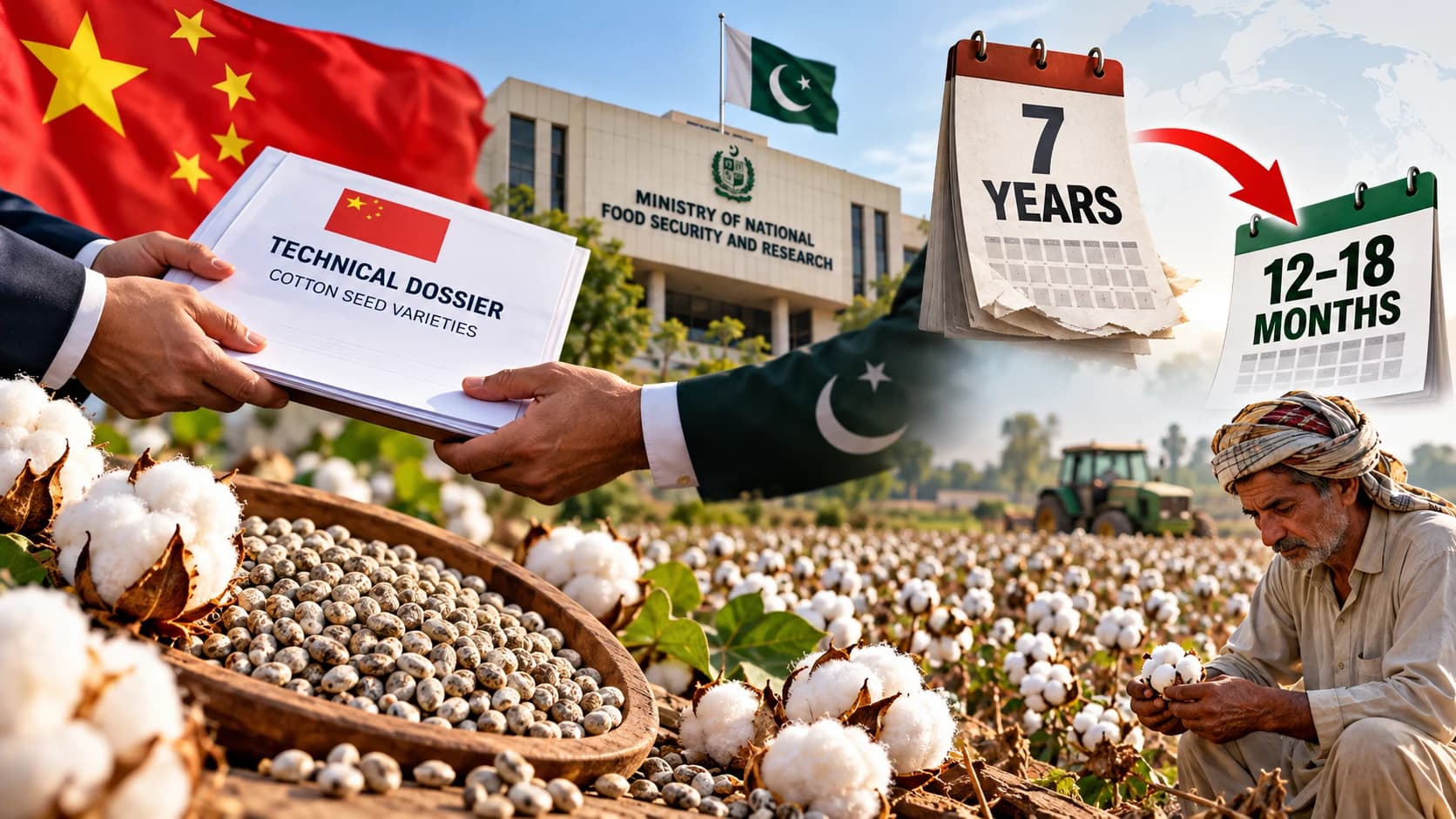
ISLAMABAD, Oct 29 (Focus Pakistan) — Pakistan cotton seed approval could shrink from roughly seven years to just 12 to 18 months under a government proposal, as China submits technical documents and farmers in Punjab increasingly turn to competing crops.
Federal Minister for National Food Security and Research Rana Tanveer Hussain put the fast-track proposal at the centre of a high-level meeting on Thursday, part of a Cotton Revival Strategy his ministry hopes will make the crop pay again.
Nothing has changed yet. First, officials have to check whether the idea fits the legal and regulatory framework already on the books. The ministry says mandatory scientific testing stays. So do biosecurity and biosafety checks. Cotton-sector representatives at the meeting supported efforts to speed up approvals.
The meeting confronted a crop in retreat. Punjab’s cotton growers have faced mounting pressure. Yields keep falling while the cost of growing cotton keeps rising, and the margin in between has thinned out. Growers have turned to sugarcane or maize instead.
Officials named Cotton Leaf Curl Virus among the biggest threats to production. Pest attacks and erratic weather made the list too. So did poor-quality seed and the shortage of machinery on farms.
The minister said a revival would strengthen the farm economy, support the textile industry and cut Pakistan’s reliance on imported raw material.
China submits its dossier
Foreign seed sits at the heart of the plan. The Department of Plant Protection said China has submitted its technical dossier, and Pakistani officials have asked for more information.
Officials also reviewed cooperation with Türkiye, Syria and Kenya. The United States, Mexico, Kyrgyzstan and Australia featured as well, though progress there depends on their replies.
Rana Tanveer ordered the department to clear its backlog of pest risk analyses and controlled import permits faster. He set one condition: every import must still meet phytosanitary rules.
The ministry also wants to rebuild local breeding. It plans a three-member committee, led by the Pakistan Agricultural Research Council with the NationalSeed Development and Regulatory Authority and the Pakistan Central Cotton Committee, to acquire exotic cotton germplasm. The committee will map out technical requirements, funding needs and acquisition arrangements.
Private seed companies stand to gain. Officials plan a mechanism to give them access to germplasm that public research institutions already hold.
Also Read: Pakistan Grid Battery Estimate Soars Nearly Fivefold After Eight-Year Delay
Government breeders face tougher scrutiny in return. The ministry wants clear targets for public-sector research, with accountability tied to results. It also proposed incentives for successful breeders. The goal is high-yielding, climate-resilient varieties that farmers can grow at a profit.
The GM hurdle
Genetically modified cotton, including Bt varieties, faces an additional regulatory hurdle. Any such variety needs biosafety clearance from authorities under the Ministry of Climate Change and Environmental Coordination. Disputes that need a higher-level policy call may go to the prime minister.
Officials want regional performance to carry greater weight in variety approvals, rather than one national yardstick. The minister directed NSDRA to speed up promising varieties from field trials and to make basic seed available.
Then there is the labour problem. Pickers are getting harder to find, so participants talked about single-pick varieties that machines can harvest in one pass. They also discussed reviewing taxes on agricultural machinery. Organic cotton got a mention, and carbon credits did too, both pitched as ways to make Pakistani cotton more competitive abroad.
Rana Tanveer closed by ordering every institution to send the ministry actionable proposals. The seven-year wait still stands. The 18-month version exists, for now, only as a proposal.