
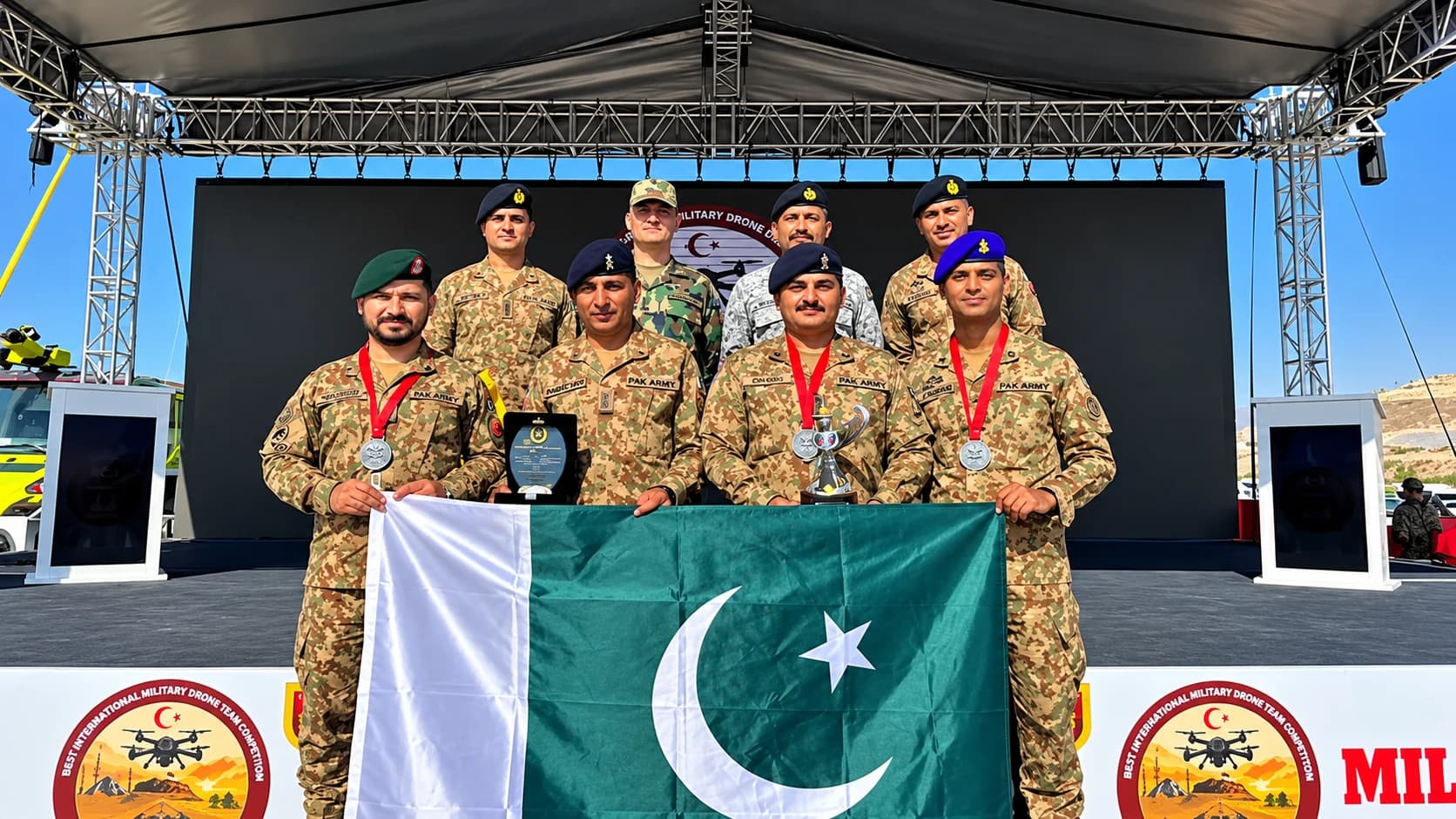
ANKARA, Oct 25 (Focus Pakistan) — Pakistan’ army drone pilots beat Italy by 0.427 seconds to take second place at Türkiye’s first international military drone competition. The ceremony that crowned them also heard the Turkish military chief call for 10 million kamikaze drones within a decade.
The Pakistani team, from the army’s 44 Signals Regiment according to Pakistani media, flew the 23-obstacle final course in 50.253 seconds. Italy finished in 50.680 seconds. A single late turn would have wiped out that gap.
The Turkish Land Forces team won in 41.417 seconds, and France came fourth in 57.142 seconds, Turkish news agency DHA reported.
A final without a single mistake
The Best International Military Drone Team Competition (BIMDTC-2026) drew 22 teams from 18 countries to Temelli, on the outskirts of Ankara, while 14 more countries sent observers. The Turkish Land Forces Command ran the five-day event.
Each team fielded three soldiers, two of them pilots. In the speed-and-manoeuvrability final, all four finalists cleared every obstacle without an error, so the clock alone decided the medals.
Also Read: World Bank Says Pakistan Could Triple Incomes by 2050 Through Sweeping Economic Reforms
Türkiye beat Pakistan by 8.836 seconds. Pakistan finished 6.889 seconds ahead of France.
Pakistani media reported a second silver for Pakistan. Captain Talha finished runner-up among more than 100 military pilots in the individual standings. Turkish coverage of the ceremony named only the team results.
Land Forces Commander General Metin Tokel handed Pakistan its trophy. Sudan’s land forces chief, Lieutenant General Malik Altayeb Khogali Alneil, presented the bronze to Italy.
The bigger number in the room
The ceremony’s starkest figure did not come off the scoreboard.
Chief of General Staff General Selçuk Bayraktaroğlu told the audience that Türkiye aims to produce 5 million kamikaze drone systems in five years and 10 million in ten, according to DHA.
“In the combat concept of the future, the centre of combat is no longer the front line but decision time and perception management,” he said. The military wants drones to protect its troops, cut casualties and raise operational effectiveness. He also put local content in Türkiye’s defence industry at 83%, He added
ASELSAN general manager Ahmet Akyol and STM general manager Ömer Güleryüz attended, as Turkish firms showed drone and counter-drone systems on the sidelines.
Why a race matters
The pilots flew first-person-view (FPV) drones. These small, fast aircraft stream live video to goggles worn by the operator. Armies now use the same kind of craft for reconnaissance and strikes, and the wars in Ukraine and the Middle East have pushed them to the centre of modern combat.
A timed race cannot reproduce a battlefield. It does measure the skills an FPV operator needs most: hand control, spatial judgement and reaction speed under pressure.
On those measures, Pakistan’s signals soldiers finished ahead of two NATO armies, Italy and France. The result says nothing about Pakistan’s drone industry or weapons. It does show that its operators can compete with Europe’s.
Partners on the podium
The ranking carries diplomatic weight too. Pakistan and Türkiye already share deep defence ties, and Baykar drones stood on display at the venue.
Still, the hosts left little doubt about who leads. Türkiye entered five teams across its army, navy, gendarmerie and special forces, then took gold by nearly nine seconds.
For Pakistan, the margin that mattered sat at the other end of the podium: 427 milliseconds, the time it takes to blink twice.