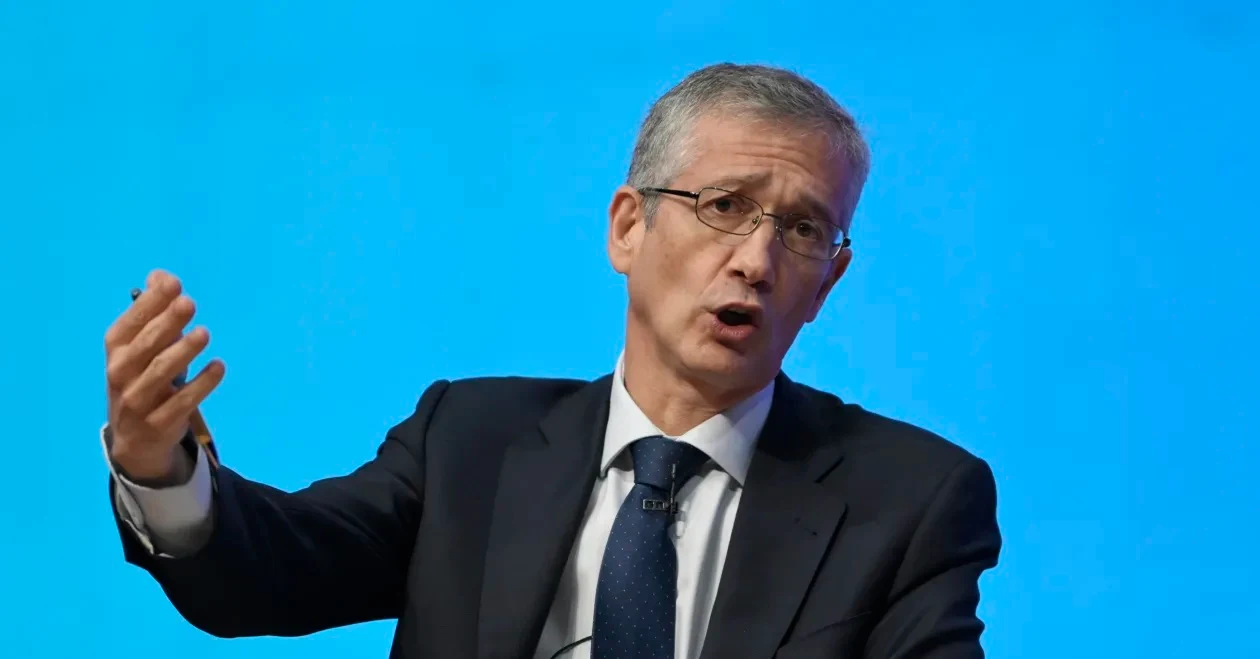
MADRID, Nov. 27 (Focus Pakistan) - Pablo Hernández de Cos is set to succeed Christine Lagarde as president of the European Central Bank (ECB) next year, multiple media reported on Thursday.
Euro zone leaders backed the Spanish economist at the European Council Summit after weeks of political wrangling. Reuters, citing European diplomatic sources, said the Netherlands agreed to support de Cos after it had pushed Klaas Knot, the only other candidate, until the final stage.
The appointment still needs formal approval after consultation with the European Parliament and the ECB's Governing Council. Neither has veto power. The winner will serve an eight-year term.
Lagarde has said she will step down on February 7, 2027, over seven years after she became the first woman to lead the central bank.
De Cos is a 55-year-old career central banker who started as a researcher at the Bank of Spain in the 1990s and served as its governor from 2018 to June 2024. He chaired the Basel Committee on Banking Supervision from 2019 to 2024 and has been General Manager of the Bank for International Settlements since July 2025.
Also Read: Pakistan Five Biggest Banks Hold 57% of Banking Assets
Representatives of Germany, France, Italy, Spain and the Netherlands have been horse-trading to secure seats on the six-member Executive Board. Germany's Markus Brunnermeier is expected to become chief economist, while France's Laurence Boone has reportedly been tapped to head the Markets Portfolio.
Neither dove nor hawk
Analysts say more than two decades of commentary and decisions at the Bank of Spain paint de Cos as moderately dovish, but also a pragmatist who adapts. He backed sharp rate hikes during the energy price shock that followed Russia's invasion of Ukraine in 2022. He also stood firmly behind negative rates and the huge stimulus launched by then-president Mario Draghi in 2019.
Asked in 2024 whether he was a hawk or a dove, de Cos said he was an "owl", stressing his focus on data.
“His monetary policy views may well be regime-dependent,” said Christian Kopf, head of fixed income and foreign exchange at Union Investment. “We are now clearly in a higher-inflation regime.”
Kopf said de Cos had the strongest technical grasp of central banking among the contenders, which matters when central bank independence is under assault in the United States and Japan. He described the Spain, Germany and France line-up as a carefully crafted package deal that balances north and south, since northern countries are seen as more hawkish and southern ones as more dovish.
John Orchard of OMFIF said de Cos had earned respect even from hawkish northern observers. The strong growth of Portugal, Italy, Spain and Greece, once the sick men of the sovereign debt crisis, also helped his case, while Germany has stuttered under high industrial costs and a struggling autos market.
France's fiscal bind
The new president will have to set policy for 21 economies growing at different speeds, and France is the immediate worry. The bloc's second-biggest economy is teetering on the edge of a potential debt crisis, with investors pushing up its borrowing costs despite efforts to bring the deficit down to around 5 percent of GDP.
Political uncertainty ahead of France's presidential election in April is hurting business activity. Far-right and far-left candidates are pulling ahead, and the widening spread over German yields has fuelled speculation that the ECB may need liquidity injections or its never-used Transmission Protection Instrument.
Any such step would be politically controversial unless Paris accepted tough fiscal discipline, which could get complicated if Marine Le Pen wins. Ken Egan of KBRA said the situation was “some way” from a serious conversation about intervention, noting that spreads had tightened a bit in recent weeks.
Inflation and the road ahead
De Cos takes over as price pressures surge again. Euro area inflation rose to 4 percent in October, the highest in more than three years, with energy the biggest contributor as the Iran war pushes up oil and gas prices.
The central bank must keep higher energy costs from spreading into wages and wider prices without hurting growth. He will also inherit the digital euro plan and the long-delayed capital markets integration.
Elections in Finland, Greece, Italy, Estonia, Slovakia and Slovenia are due next year as well. Lagarde, for her part, told the European Banking Congress in Frankfurt this month that AI combined with cyber threats keeps her awake at night.