
ISLAMABAD, Nov 27 (Focus Pakistan) – The latest FBR excise duty relief allows eligible Pakistani manufacturers to purchase selected industrial solvents without paying an upfront tax of Rs80 per litre. The move comes nearly five months after the government introduced the levy to curb fuel adulteration.
The Federal Board of Revenue (FBR) notified the changes on Thursday, allowing manufacturers to import or locally purchase white spirit, mineral turpentine oil and solvent oil without paying the duty, subject to certain conditions.
The move could bring considerable financial relief to paint and chemical manufacturers. Printing ink, varnish and adhesive producers also stand to benefit.
The government introduced the duty in July to curb fuel adulteration. But the levy also affected businesses that had long used these petroleum products as industrial raw materials.
Under the revised Federal Excise Rules, 2005, notified through SRO 2286(I)/2026, manufacturers can approach their respective tax offices for permission to purchase the materials duty-free.
Also Read: FBR Sets 55% Tax Valuation for Copper Exporters’ Steel Scrap
The government has not abolished the tax. It has instead introduced a system under which factories will receive individual allocations based on their manufacturing requirements.
Millions of Rupees at Stake
For industrial buyers, Rs80 a litre can quickly add up.
A paint factory requiring 25,000 litres of solvent would need Rs2 million just to cover the excise duty. On a purchase of 100,000 litres, the amount rises to Rs8 million.Large factories with considerably higher consumption may have tens of millions of rupees tied up in such payments.
The calculations below show the value of the duty at different purchase volumes.
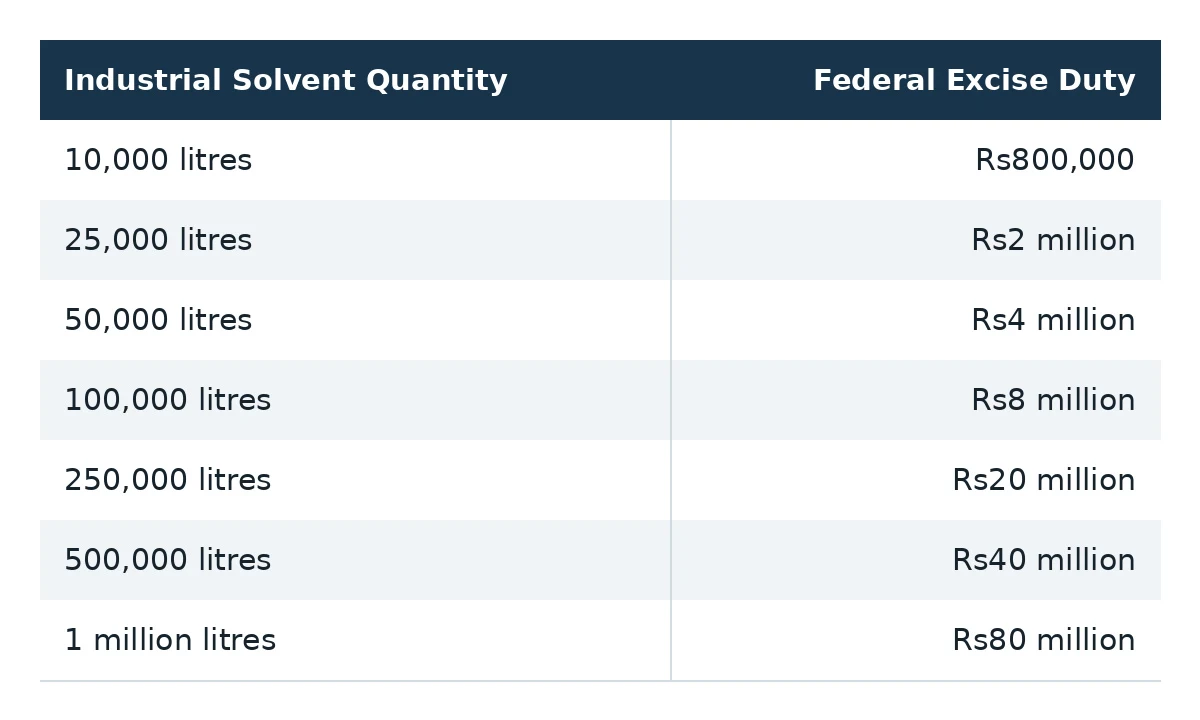
These figures reflect the statutory duty rate rather than an FBR assessment of industry-wide relief. For manufacturers already entitled to tax adjustments, the issue is largely one of cash flow. They pay the duty when buying raw materials and adjust it later.
Between those two transactions, the money remains unavailable for other purchases or factory expenses.
Production History to Determine Quotas
How much a factory can buy under the concession will depend on its production record and raw material requirements.
The FBR has provided two benchmarks for existing manufacturers. Tax officials will consider last year's output and the average output of the preceding two years, taking whichever figure is higher.
The rules allow another 10 percent on top of the applicable benchmark.
This could benefit factories that experienced a decline in production during the most recent financial year.
For new manufacturing units, the FBR has adopted a different formula. Factories operating for less than a year can seek allocations based on up to 50 percent of their installed annual capacity.
The Commissioner Inland Revenue will have one month to decide applications.
Businesses need not wait for the FBR to launch an online application system. They can submit their applications manually in the meantime.
Stocks Purchased Since July Also Count
One provision in Thursday's notification could affect the immediate availability of duty-free material. The tax department will account for opening stocks as of July 1, along with relevant purchases made subsequently. A factory's approved annual quota, therefore, may not represent the quantity it can immediately order from suppliers.
The notification also deals with applications where tax officials question a manufacturer's declared solvent requirements. Commissioners can grant provisional allocations while specialists examine the consumption figures. The rules provide for further interim allocations in certain cases where technical assessments remain pending.
Six Months to Consume Raw Materials
A tax registration number alone will not secure the exemption. Applicants also need a valid Form-L licence from the Department of Explosives. They must furnish details of their factories, installed capacity, products and raw material consumption.
Manufacturers of taxable goods and their suppliers must participate in the FBR's electronic invoicing system. Factories will have six months to consume the solvents they acquire under the concession. The materials must go into production at their own manufacturing premises.
The FBR will require quarterly stock statements and annual reconciliation of purchases and consumption. Tax commissioners can withdraw allocations and recover unpaid duty where manufacturers breach the prescribed conditions. Applicable penalties and surcharges may follow.
The government has retained these restrictions to prevent industrial solvents from finding their way into the fuel market.
Borrowing Costs Could Fall
The changes may also have implications for manufacturers that depend on bank financing. A business borrowing Rs8 million to cover excise duty would incur an additional financing expense of Rs480,000 over six months at an assumed annual interest rate of 12 percent.
Actual borrowing costs will vary. But factories obtaining duty-free allocations would no longer need to arrange that particular portion of financing. Whether the change makes paint and other finished goods cheaper is difficult to establish at this stage.
Paint manufacturers also contend with fluctuations in the prices of pigments, resins, imported chemicals and packaging materials. Electricity and transportation remain additional expenses. Thursday's notification addresses the tax payable on selected raw materials, not the broader cost of manufacturing. The FBR has yet to disclose how many factories could qualify for the concession or how much revenue the government expects to forgo.