
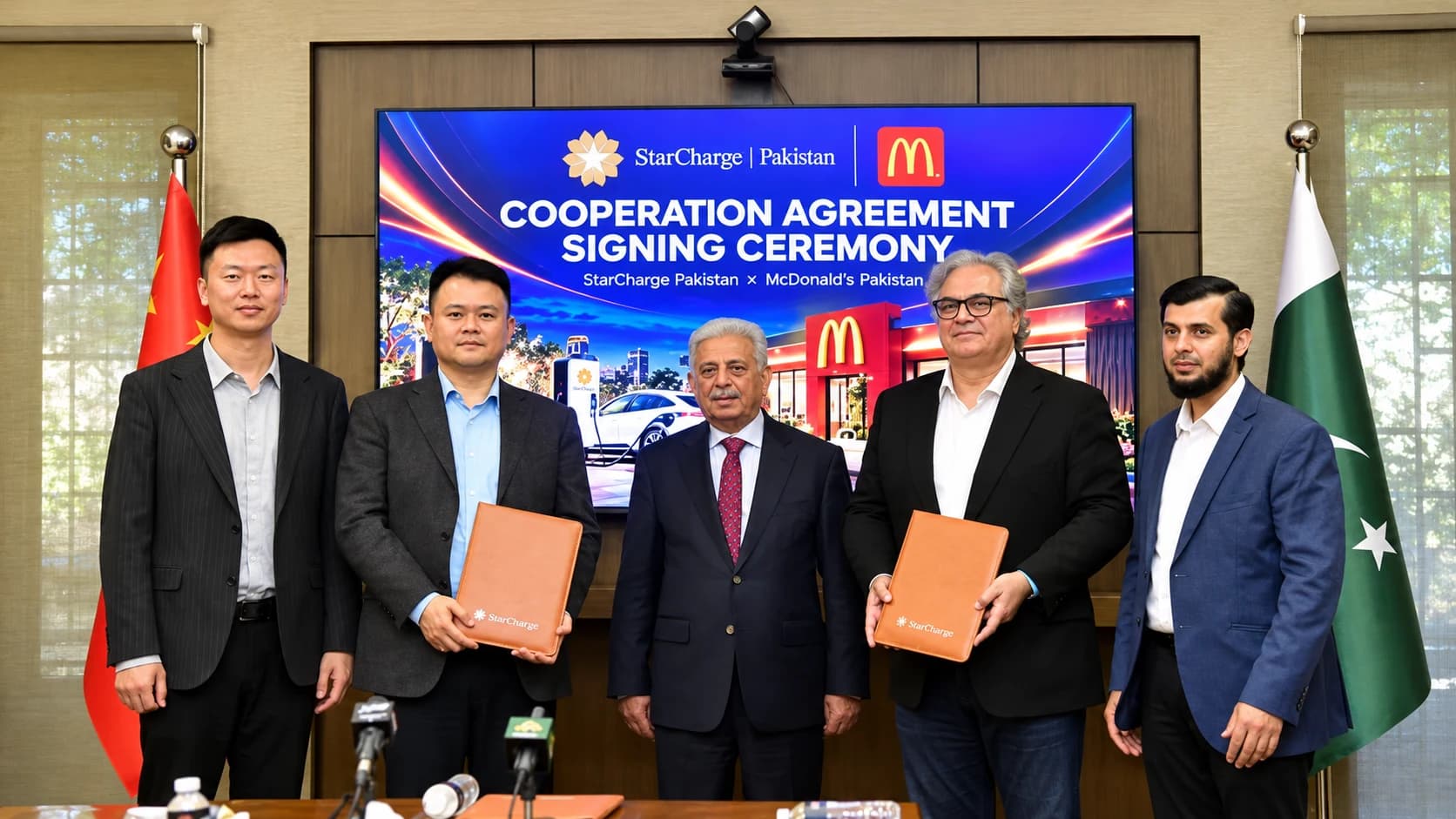
ISLAMABAD, Oct 20 (Focus Pakistan) — McDonalds Pakistan has signed an agreement with Chinese charging company StarCharge to explore putting electric vehicle chargers at its restaurants, a deal that could turn burger stops into battery stops but carries no investment figure, location list or start date.
The two companies signed the memorandum of understanding in Islamabad on Monday. Under the agreement, they will explore setting up EV charging facilities at suitable McDonald’s outlets across the country. The deal pairs StarCharge’s charging technology with the restaurant chain’s customer network.
A FOOD MINISTER AT AN EV SIGNING
The ceremony drew an unusual guest of honour. Rana Tanveer Hussain, the minister for national food security and research, attended the signing and welcomed StarCharge’s entry into the market.
The choice made more sense than it first appeared. Hussain told the ceremony that he had drawn up and announced Pakistan’s EV policy during his earlier term as minister for industries and production.
Also Read: Punjab Moves to Ban Spy Cameras Hidden in Pens, Glasses and Watches
Hussain said he had visited StarCharge’s factory in China and inspected its manufacturing facilities. He added that the government had invited the company to build charging stations in Pakistan, and he singled out its plan to target McDonald’s locations offering drive-through service.
Better batteries have not solved everything, in his view. Drivers still need chargers on motorways and long trips, he said, even though EV ranges keep improving.
3,000 STATIONS ON PAPER
The deal lands in a market where official ambitions far outrun the hardware on the ground.
The targets look bold. The National Electric Vehicle Policy 2025-30 wants three in every 10 new vehicles sold by 2030 to run on electricity. By then, officials expect 2.2 million EVs on Pakistani roads and want 3,000 charging stations ready for them.
Officials told a National Assembly committee in June that more than 100 charging stations had received licences nationwide. Senator Khalida Ateeb, who chaired a Senate panel on the issue in July, called the 3,000-station target insufficient.
The policy also plans 40 charging stations along motorways, roughly 105 kilometres apart. Capital authorities have moved to require chargers at new petrol pumps and large buildings, and Hussain said Lahore and Islamabad development authorities now make charging facilities mandatory at major malls and high-rise buildings.
Monday’s agreement marks StarCharge’s second Pakistan announcement in three months. Back in July, its local arm, StarCharge Energy Pakistan, inked a memorandum with Chinese firm Bahum Global Ltd for a nationwide charging network, with Bahum handling the technical side.
No station count followed. No map or timetable either.
THE MISSING NUMBERS
The companies kept the key numbers to themselves. They gave no investment figure and no list of restaurants or cities. They said nothing on whether outlets would get fast chargers, the kind that make sense during a short meal, or slower units better suited to long stays.
Pricing also remains unknown. Pakistan’s regulator previously fixed the EV charging tariff at Rs23.57 per unit, but neither partner said what drivers would pay at McDonald’s outlets or whether diners would get any discount.
For motorists weighing an EV purchase, that leaves the deal as a statement of intent. The first working charger at a McDonald’s drive-through will show whether burger stops can genuinely fill gaps in Pakistan’s thin charging map.