

ISLAMABAD, Nov. 24 (Focus Pakistan) – Pakistan's electricity distribution companies carry the highest corruption risk among 25 federal public sector institutions, according to a new government assessment that places the country's tax authority second and the Capital Development Authority third.
The National Risk Assessment of Corruption Vulnerabilities gives the power distribution companies (DISCOs) a score of 61.1, making them the only institutional group in the high-risk category. The Federal Board of Revenue follows at 54.4, and the CDA at 49.5.
None of the institutions entered the very high or extremely high-risk categories.
The government prepared the report under Reform Action 11 of the Prime Minister's Economic Governance Reforms, with the National Accountability Bureau as technical lead. The Ministry of Law and Justice coordinated the exercise, which tested the 25 institutions against more than 300 indicators using audit findings, regulatory records and information from investigative agencies.
Corruption Risks Extend to Essential Public Services
The institutions at the top of the list handle electricity bills, taxes, land approvals in the capital, highway contracts, wheat procurement and financial assistance for low-income households.
Also Read: NEPRA Removes K-Electric From DHA City Karachi Power Purchase Deal
The Pakistan Agricultural Storage and Services Corporation (PASSCO), which buys and stores wheat, ranked fourth with 47.1. The National Highway Authority came fifth at 43.4, Pakistan Railways sixth at 41.1 and the Benazir Income Support Programme (BISP), the government's main cash assistance scheme for low-income families, seventh at 40.1.
Pakistan Post placed eighth at 39.9. Sui Northern Gas Pipelines Limited (SNGPL) and the Evacuee Trust Property Board completed the top 10, each scoring 39.3.
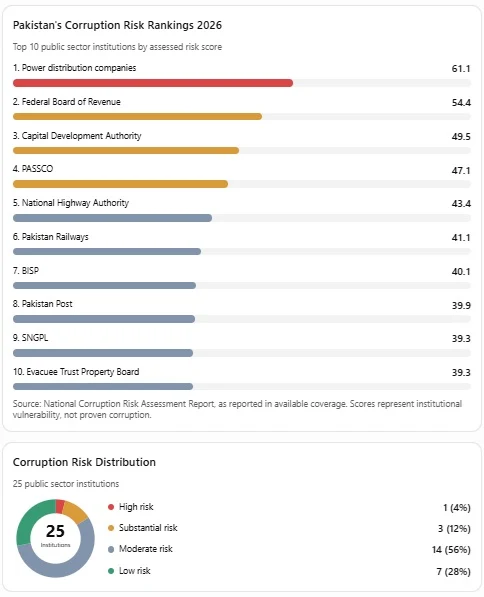
A comparison of the scores shows a sharp break at the top. DISCOs lead the FBR by 6.7 points, while the tax authority sits 4.9 points ahead of the CDA. The gap narrows considerably further down: only 0.8 points separate the four lowest-scoring institutions in the top 10. Between first and tenth place, the spread stands at 21.8 points.
Thousands of Complaints Against DISCOs
The assessment records 6,492 complaints involving power distribution companies, along with 1,653 inquiries, investigations and first information reports, and 450 references and challans.
The report identifies five major vulnerabilities within DISCOs: procurement non-compliance, revenue leakage, stores pilferage and payroll irregularities, patronage appointments, and a uniform tariff mechanism that encourages inefficiency.
DISCOs also topped the assessment's first-stage screening with a score of 92.7, ahead of the NHA at 79.1, before the detailed second-stage review confirmed them as the only institutional group in the high-risk category.
The figures do not show how many complaints ended in convictions, or how much money the institutions lost to corruption.
Risk, Not a Verdict
The assessment developed detailed indicators for 10 of the 25 institutions. It identified 56 institution-specific corruption risk patterns, 10 governance patterns common to several institutions and 18 regulatory risk patterns.
The assessment measures institutional vulnerability across five dimensions: exposure, risk signals, controls, impact and data opacity.
Law Minister Azam Nazeer Tarar stressed at the launch that the report serves as a guide for reform rather than a "charge sheet" against any institution.
A high score identifies weaknesses that could enable corruption without establishing wrongdoing by individual officials.
Government Proposes 396 Anti-Corruption Reforms
The government has proposed 396 reforms in response to the findings, covering merit-based appointments, digitisation of official records, better data sharing between departments and stronger institutional oversight.
For DISCOs, the measures include energy accounting at feeder level, staff rotation and tying the companies' allowed revenue to loss-reduction and recovery targets.
The assessment forms part of Pakistan's governance commitments under its $7 billion International Monetary Fund programme. The IMF's Governance and Corruption Diagnostic Assessment, which the Finance Division published in November 2025, found corruption vulnerabilities at every level of government and recommended that Pakistan adopt a risk-based approach, with mitigation plans for its highest-risk federal agencies and annual progress reports.
The government now faces the task of implementing 396 corrective measures across institutions that manage public money and deliver essential services. For millions of Pakistanis who depend on these agencies, the real measure of progress will come through stronger accountability, fewer financial leakages and better public services.