
KARACHI, Nov. 23 (Focus Pakistan) - The Pakistan Textile Exporters Association (PTEA) has sent the Prime Minister and the Finance Minister a draft plan to boost textile production and exports. PTEA Secretary General Azizullah Goher announced this in Faisalabad.
The plan asks the government to lower production costs, cut bank profit rates, allow duty-free import of raw materials, and remove duties and taxes. Goher also asked that the energy tariff be fixed for one year. He wants the industry given incentives on the pattern of the Drawback of Local Taxes and Levies (DLTL) scheme. Industrialists also asked that refund claims be paid within 24 hours.
Goher said that if the formula is approved, exports could rise from $18 billion to $25 billion.
Exports are flat despite the sector's weight
The exporters' $18 billion figure matches official data. Pakistan's textile and apparel exports rose 0.3 percent to $18 billion in FY2025-26, their highest level in four years, even as total exports fell 5.9 percent, according to the Pakistan Textile Council (PTC). A separate report described textile exports as stagnating at $17.9bn in FY26.
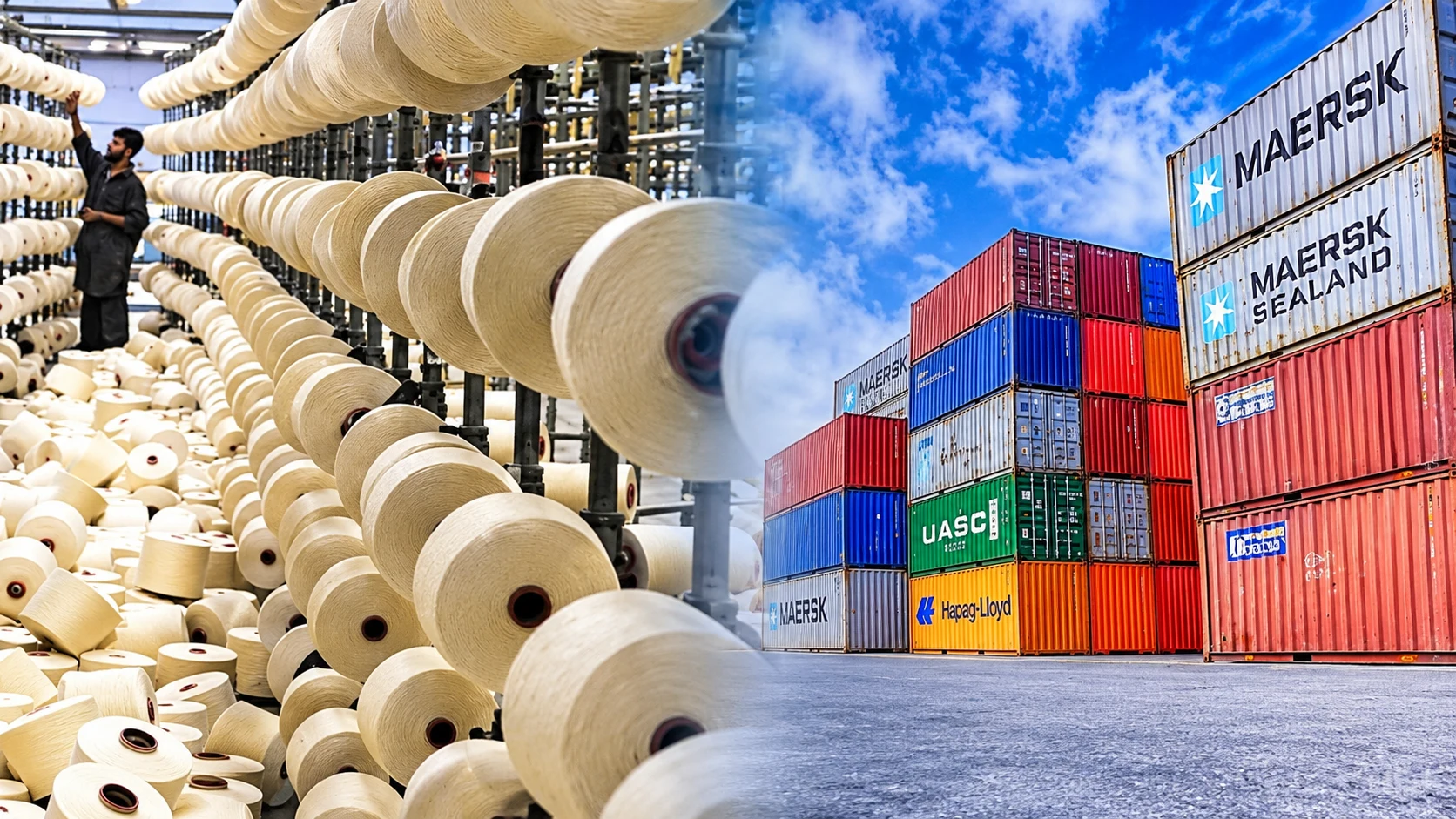
The textile sector accounts for around 60% of Pakistan's exports and 8.5% of GDP, and employs nearly 40% of the manufacturing workforce, according to the All Pakistan Textile Mills Association (APTMA).
Pakistan also lags its regional rivals. In FY2024-25, its textile exports were $17.88 billion, against $40.22 billion for Bangladesh and $36.61 billion for India.
Recent months have brought some improvement. Textile exports rose 5.26 percent in July-September of the current fiscal year, to $5.026 billion, according to the Pakistan Bureau of Statistics (PBS). Readymade garments led the gain with growth of 15.69 percent.
Industry bodies say high costs remain the main obstacle. In January, APTMA asked the Finance Minister to remove the Rs4–7 per unit cross-subsidy and the Rs3.23 per unit debt servicing surcharge, and to replace peak-hour rates with a flat tariff.
APTMA has also said that industrial consumers in Pakistan pay well above the 5–9 cents/kWh benchmark seen in India, Bangladesh, China and Vietnam. The PTC has proposed restoring regionally competitive energy tariffs at around 8.5 cents per kWh and removing gas levies.
Exporters met commerce ministry officials in February and pointed to the heavy burden of upfront taxes, elevated energy tariffs, infrastructure constraints and persistent liquidity problems. In April, APTMA wrote to the central bank governor asking for higher export refinance limits, citing liquidity constraints from higher energy costs, supply chain disruptions and geopolitical uncertainty.
Before the June budget, manufacturers said more than 140 factory closures had wiped out about a third of sector capacity. Earlier, APTMA's chairman said about 150 large textile units had shut down in two years, leaving hundreds of thousands of workers jobless.
Also Read: Services Exports Cross $10 Billion for First Time, Commerce Minister Says
The PTC's annual report also pointed to losses in export markets. Exports to the UK fell to $1.730 billion amid competition from India's tariff-free access under the UK-India trade agreement. Exports to the EU, Pakistan's largest market, slipped to $7.103 billion from $7.248 billion.
Industry leaders argue that reform could unlock much more. The PTC chairman said rationalizing taxes could raise textile exports by as much as $4 billion as buyers look to diversify away from China. The PTEA has separately said textile exports could realistically reach $27 billion by FY2028 with structural reforms. The government has acknowledged the sector's importance. In January, Finance Minister Muhammad Aurangzeb acknowledged its central role in exports, employment and industrial output.