
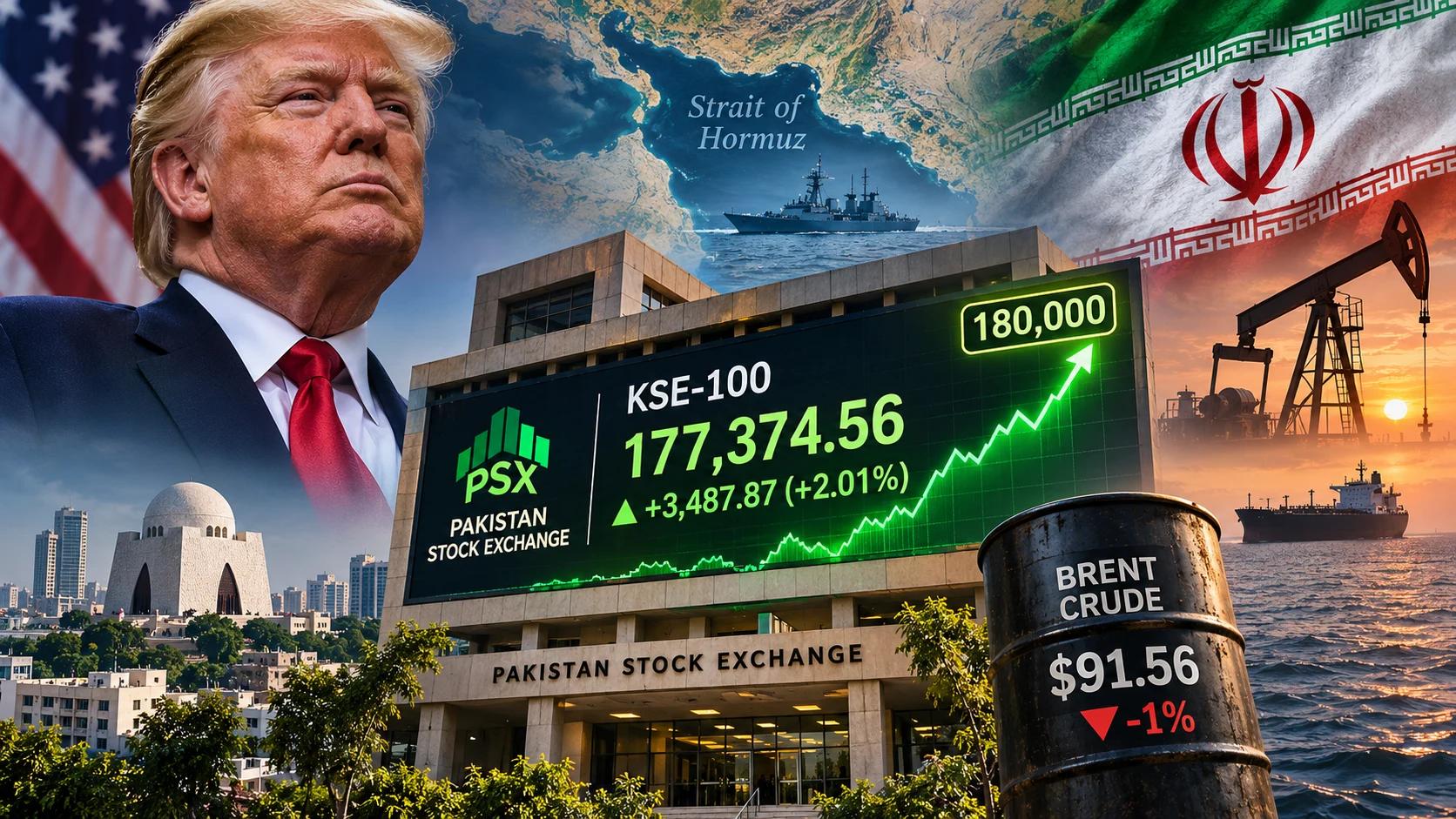
KARACHI, Nov. 10 (Focus Pakistan) — The PSX rally today sent Pakistani stocks soaring nearly 3,500 points in the first 80 minutes of trading Tuesday, as investors welcomed U.S. President Donald Trump's decision to hold off on further strikes against Iran. The benchmark KSE-100 index surged toward 180,000 as global oil prices fell and geopolitical tensions eased.
By 10:50 a.m., the KSE-100 stood at 177,374.56. That put it 3,487.88 points, or 2.01%, above Friday’s close of 173,886.69, Business Recorder reported. The exchange stayed shut Monday for Allama Iqbal Day.
Friday had ended badly, with a 1,493-point drop. Tuesday’s gains more than doubled that loss inside the first hour and a half. At Friday’s close, PSX figures put the index 0.10% lower for the year. Tuesday’s rise took it back above where it started 2026.
Dealers now talk about 180,000, roughly 2,600 points off. It is a round number, not a record. Over the past 52 weeks the index peaked at 191,032.73, according to the exchange, about 7% above Tuesday’s level.
Trump said Monday that U.S. military action against Iran is not necessary “at this point.” He plans to hold off on new strikes after appeals from regional countries, including Qatar’s prime minister, Reuters reported. The U.S. Navy will go on blockading the Strait of Hormuz for now, he said.
Brent settled 5.85% lower Monday, its weakest finish since Aug. 31, according to Reuters. Asian trading Tuesday knocked off another 1%, leaving it at $91.56 a barrel. Crude had traded above $100 earlier in the conflict.
Tim Waterer of KCM Trade told Reuters that traders keep putting weight on what he called Trump’s “more conciliatory tone toward Iran since the midterms.”
THE PAKISTAN ANGLE
Oil is Pakistan’s sore spot. The country buys most of its fuel overseas, so the oil import bill eats into the dollars the central bank holds. When crude drops, Pakistan needs fewer dollars to pay for it, and the rupee comes under less strain.
Also Read: Pakistan’s stock exchange earns 37% more, pays shareholders 41% less
Pump prices come next. Islamabad resets petrol and diesel rates twice a month, and the next change is due around Nov. 15. If crude stays near $90, the oil regulator’s calculation could leave room for a cut. Cheaper diesel lowers freight costs, which helps keep food prices down.
At the State Bank of Pakistan, monetary policy will reflect these numbers. Easing oil costs could strengthen the case for steady or lower interest rates, a key driver of local stock valuations.
Investors bought shares across automobile assemblers, cement makers, commercial banks, oil and gas explorers, oil marketing companies and power producers.
Mari Energies, Oil and Gas Development Company and Pakistan Petroleum all rose, even though falling crude usually trims explorers’ revenue. The move suggests investors cared more about lower risk than lower earnings. Pakistan State Oil and Hub Power also advanced. Habib Bank, MCB Bank, Meezan Bank and United Bank Limited joined the climb.
The KSE-100 gained 7,477.44 points, or 4.5%, last week, its strongest weekly performance in nearly six months, according to Business Recorder.
Regional markets moved the same way. South Korea’s KOSPI jumped more than 5%, and Japan’s Nikkei rose about 3% in early trading.
IRAN PUSHES BACK
Tehran rejected the hopeful tone. Iranian security council chief Mohsen Rezaei said Washington should “stop manufacturing fake news about imaginary talks.” He declared it “time to surrender to the seven conditions Iran has repeatedly set out,” according to Reuters.
Nick Twidale, chief market strategist at ATFX Global, said the latest developments offer hope for an end to the U.S.-Israeli war with Iran, which erupted in late February. He cautioned, however, that a wide gap still separates diplomacy from a lasting peace agreement.
“While attacks on shipping around the Strait of Hormuz are still occurring, they have not escalated in a way that has forced a fresh risk premium into the market,” Waterer said.
Traders now await U.S. inflation data and domestic corporate results. One sharp turn in the Gulf could reverse the gains quickly.
For now, Karachi’s bulls own the floor.